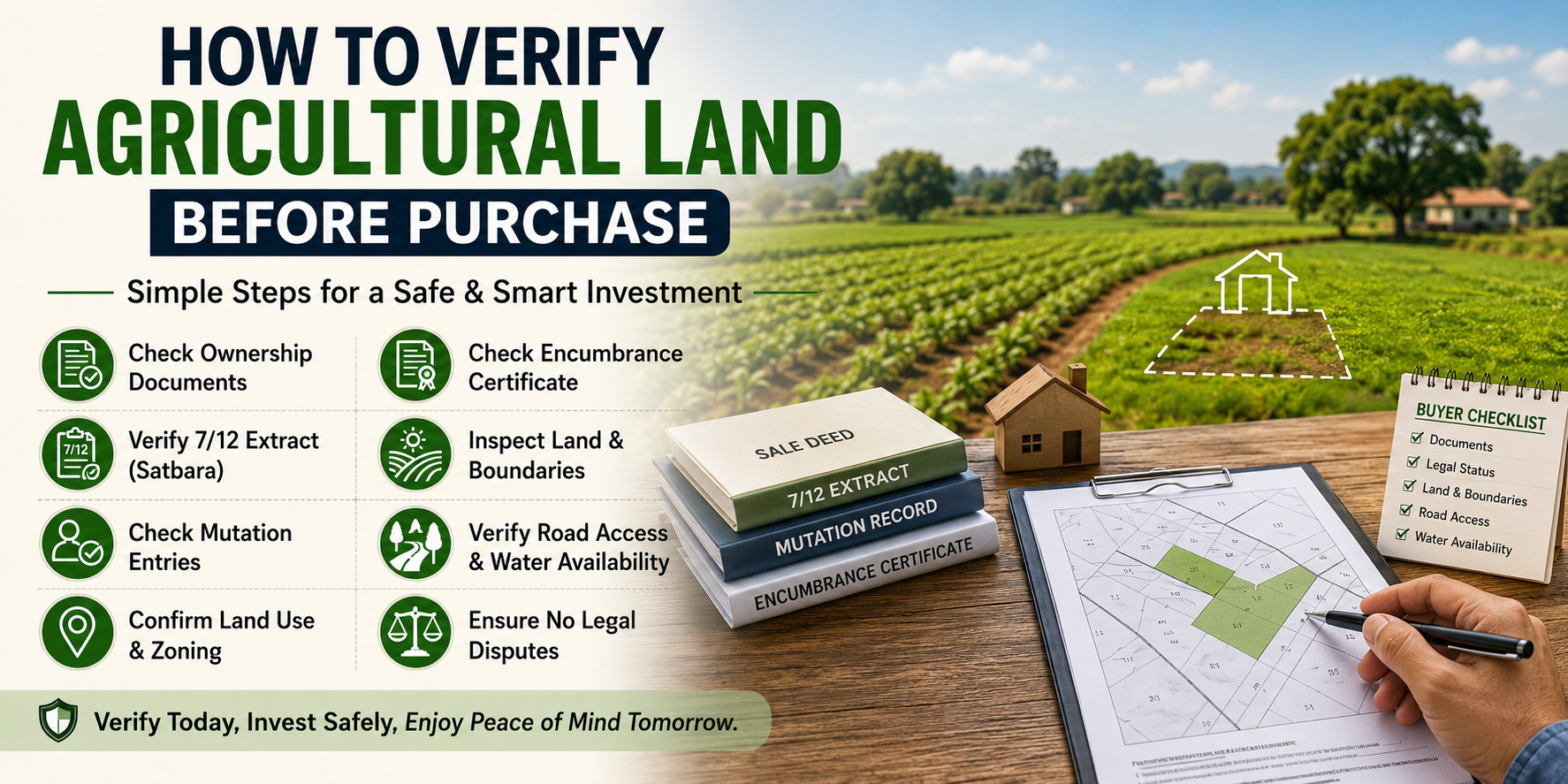
How to Verify Agricultural Land Before Purchase in India

Buying agricultural land is a dream for many people today. Some want to build a peaceful farmhouse away from city life, while others see farmland as a smart long-term investment. In recent years, places around Nashik, Pune, Karjat, and Alibaug have become especially popular for agricultural plots and farmhouse projects.

But before you invest your hard-earned money, one thing is extremely important — proper land verification.

Many buyers make the mistake of trusting brokers or verbal promises without carefully reviewing the legal documents. Unfortunately, this can lead to disputes, fraud, or even loss of ownership in the future.

If you are planning to buy agricultural land in 2026, this guide will help you understand exactly what to verify before making the purchase.

Why Land Verification Is So Important

Unlike apartments or ready homes, agricultural land involves multiple legal and government records. Even if a plot looks attractive, hidden issues may exist behind the paperwork.

Some common problems buyers face include:

  1. Ownership disputes
  2. Fake documents
  3. Illegal possession
  4. Encroachments
  5. Loan liabilities
  6. Government restrictions
  7. Missing road access

A little verification today can save years of stress later.

1. Check Who Actually Owns the Land

The first thing you should verify is whether the seller is the real owner of the property.

Ask for:

  1. Sale deed
  2. Title documents
  3. Previous ownership records
  4. Inheritance papers (if applicable)

Make sure:

  1. The seller’s name matches all government records
  2. There are no missing ownership transfers
  3. No family disputes are involved

If possible, get the title checked by a property lawyer. It may cost a little now, but it can protect a much bigger investment later.

2. Verify the 7/12 Extract (Satbara)

If you are buying land in Maharashtra, the 7/12 extract is one of the most important documents.

This document contains:

  1. Owner details
  2. Survey number
  3. Land area
  4. Crop details
  5. Loan entries
  6. Legal remarks

Check carefully whether:

  1. The owner’s name is correct
  2. Any bank loan exists on the land
  3. There are disputed remarks
  4. The land area matches what is being sold

Never ignore this document while buying agricultural property.

3. Check Mutation Entries (Ferfar)

Mutation records show the history of ownership changes.

These records help you understand:

  1. Who owned the land previously
  2. Whether ownership transfers were legally updated
  3. If inheritance records are complete

Sometimes land is sold without proper mutation updates, which creates future legal complications.

4. Confirm the Land Zone & Usage Rules

Many buyers assume they can build a farmhouse anywhere on agricultural land — but that is not always true.

Some lands fall under:

  1. Green zone
  2. Forest zone
  3. Restricted development zone
  4. Government reservation area

Before buying, visit the local town planning office and confirm:

  1. Whether farmhouse construction is allowed
  2. NA conversion possibilities
  3. Development restrictions
  4. Future road or industrial plans nearby

This step is extremely important if you plan to develop the property later.

5. Check for Loans or Legal Liabilities

Sometimes, landowners take loans against their agricultural property.

If you buy such land without verification, you may face legal issues later.

Ask for an Encumbrance Certificate (EC) to check:

  1. Bank loans
  2. Mortgages
  3. Court attachments
  4. Financial liabilities

A clear EC means the property is legally safer to purchase.

6. Visit the Land Personally

Never buy land only by looking at photos, videos, or brochures.

Visit the site personally and check:

  1. Actual boundaries
  2. Road connectivity
  3. Nearby development
  4. Water availability
  5. Encroachments

Many buyers realize later that the physical land is different from what was promised.

7. Verify Road Access

This is one of the most ignored but important checks.

A beautiful plot without proper road access can become a major problem in the future.

Ensure the land has:

  1. Legal access road
  2. Proper entry route
  3. Vehicle accessibility
  4. No disputes over pathway rights

Good road connectivity also increases future resale value.

8. Check Water Availability

Water plays a huge role in agricultural land value.

Verify:

  1. Borewell condition
  2. Groundwater availability
  3. Irrigation facilities
  4. Electricity connection for pumps

For farmhouse buyers, water availability becomes even more important for landscaping, farming, and daily usage.

9. Check Local Rules for Agricultural Land Purchase

In some Indian states, only registered farmers are allowed to buy agricultural land.

Rules differ from state to state, so always confirm:

  1. Buyer eligibility
  2. Farmer certificate requirements
  3. Local agricultural laws

A local legal advisor can guide you properly here.

10. Make Sure There Are No Court Cases

Before finalizing the deal, check whether the land is involved in:

  1. Family disputes
  2. Court litigation
  3. Government acquisition
  4. Partition cases

Even small disputes can create years of legal complications.

Important Documents You Must Verify

Here’s a simple checklist before purchasing agricultural land:

DocumentWhy It Matters
Sale DeedProof of ownership
7/12 ExtractRevenue & ownership details
Mutation EntriesOwnership history
Encumbrance CertificateLoan & legal status
Survey MapBoundary verification
Tax ReceiptsPending dues check
Identity Proof of SellerSeller verification
NA Permission (if applicable)Development approval

Common Mistakes Buyers Make

Trusting Without Verification

Many people trust verbal commitments from brokers without checking documents.

Buying Because the Price Is Cheap

Very low-priced land often hides legal or ownership problems.

Ignoring Future Development Plans

Nearby highways, industries, or zoning changes can affect land value significantly.

Skipping Legal Advice

A property lawyer can identify issues that normal buyers may miss.

Agricultural land can be a fantastic investment when purchased carefully and legally. Whether you are buying for farming, farmhouse development, or future appreciation, proper verification is absolutely essential.

Take your time.
Check every document.
Visit the property personally.
Consult legal experts when needed.

A safe land purchase today can become one of your best investments tomorrow.

Why Farmhouse Plot & Land Investments in Nashik Are Booming in 2026?

1. Why Nashik? The 2026 Investment Landscape

For decades, Nashik was known to most Indians as the city of the Kumbh Mela and the wine capital of India. But in 2026, a new identity has firmly taken root: Maharashtra’s most strategically located real estate goldmine.

Situated just 165 km from Mumbai and 210 km from Pune, Nashik sits at the intersection of the Mumbai–Agra highway (NH-3) and the Delhi–Mumbai Industrial Corridor (DMIC). What was once a pilgrimage and agricultural town has become a magnet for infrastructure investment, industrial expansion, and — crucially — lifestyle-driven land purchases.

The Samruddhi Mahamarg (Nagpur–Mumbai Super Communication Expressway), now fully operational, has fundamentally changed Nashik’s accessibility matrix. What used to be a 3+ hour drive from Mumbai is now a comfortable 90-minute journey — and that has unlocked Nashik’s potential like never before.

2. What’s Driving the Farmhouse Plot Boom

The surge in farmhouse and plot demand in Nashik in 2026 isn’t a single trend — it’s a convergence of five powerful forces:

🏗 Infrastructure Momentum

The Nashik Metro Rail Project (Phase 1 under construction), the upcoming Nashik–Pune Expressway, and the expansion of Ozar International Airport have collectively triggered a land-rush in areas that were overlooked just three years ago. Infrastructure always leads property appreciation — and Nashik is a textbook case.

🌿 Post-Pandemic Lifestyle Shift

Mumbai and Pune professionals, exhausted by urban density, are actively seeking farmhouses within weekend driving distance. Nashik — with its vineyards, Sahyadri backdrop, clean air, and relatively low cost of living — has emerged as the top choice. Demand for plots in the 2,000–10,000 sq ft range for weekend farmhouses has surged 60% since 2023.

🏭 Industrial Expansion & DMIC Tailwind

As industries relocate to Nashik (EVs, pharmaceuticals, agro-processing), a new professional class is settling here — driving demand for both residential plots and agricultural land for food/agro ventures.

🍇 Wine & Agro Tourism Growth

Nashik’s wine country — particularly Dindori, Niphad, and Igatpuri — is attracting agri-entrepreneurs who buy farmland to set up boutique vineyards, glamping sites, and agro-tourism resorts. This has created an entirely new category of buyer: the agro-investment buyer.

3. Top Zones & Localities for Plot Investment in Nashik

Not all of Nashik is equal in terms of investment potential. Here’s a breakdown of the hottest micro-markets in 2026: Igatpuri, Dindori, Sinnar, Trimbakeshwar, Niphad, Ambad / Satpur and Gangapur Road.

4. Legal & Due Diligence Checklist for Nashik Plot Buyers

Buying land in Nashik — especially agricultural or farmhouse plots — requires careful legal navigation. Maharashtra’s agricultural land laws have specific rules about who can buy non-agricultural (NA) and agricultural land.

  • 7/12 Extract (Satbara Utara):
    Verify the land record at your local Talathi office. This document confirms ownership, land type, encumbrances, and revenue history.
  • NA Order:
    For farmhouse construction, confirm the plot has a valid Non-Agricultural order from the district collector. Without it, construction is illegal.
  • Agricultural Land Restriction:
    Non-farmers cannot purchase agricultural land in Maharashtra unless an exemption applies. Confirm legal status before signing.
  • RERA Registration:
    If buying from a developer/layout, verify RERA registration (Maharashtra RERA portal). Avoid unregistered projects.
  • Title Search (30 years):
    Commission a lawyer to trace ownership history for a minimum of 30 years to rule out disputed titles or mortgages.
  • Zone Check:
    Confirm whether the land falls under Municipal, Gram Panchayat, or MIDC jurisdiction — each has different rules for construction and usage.
  • Access Road:
    Verify that the plot has legal road access (not just physical access through a neighbor’s land)


5. Who Should Invest — And Who Shouldn’t

✅ Ideal Investor Profile

  • Mumbai/Pune professionals looking for a weekend retreat with long-term capital upside
  • NRI buyers seeking emotional connection with Indian soil + rupee-denominated appreciation
  • Agro-entrepreneurs interested in vineyards, organic farming, or agro-tourism ventures
  • Long-term investors (5–10 year horizon) comfortable with illiquid assets
  • Retirees planning to relocate from metro cities to a cleaner, quieter environment

❌ Who Should Think Twice

  • Investors needing quick liquidity (land is inherently illiquid — exits can take 6–18 months)
  • First-time investors without legal/advisory support (risk of fraudulent transactions)
  • Buyers looking for rental income (farmland does not generate stable rental yields like apartments)


6. ROI Outlook: What Makes Nashik Plots Special in 2026

The return on investment from Nashik farmhouse plots and land comes from multiple layers, not just resale appreciation:

Capital Appreciation:

Primary driver. Well-located plots near Igatpuri, Gangapur Road, or Sinnar MIDC can realistically deliver 15–25% CAGR over 5 years.

Agro-Tourism Revenue:

Landowners are generating ₹2–8 lakhs per month from glamping setups, farm stays, and vineyard experiences on their Nashik properties.

Rental of Farm Output:

Agricultural land leased to tenant farmers generates 4–6% annual returns purely from cultivation revenue.

Conversion Upside:

As Nashik urbanises, agricultural land converted to NA status can see 2–4× value jumps overnight (subject to regulatory change).

7. Final Verdict: Should You Invest in Nashik in 2026?

Yes — but with eyes open and homework done.

Nashik in 2026 is exactly where Lonavala was in 2005, where Mulshi was in 2010, and where Alibaug was in 2015 — a location teetering on the edge of mainstream attention, still accessible at rational prices, but not for much longer.

The combination of world-class connectivity (Samruddhi Expressway), industrial growth (DMIC, EV manufacturing), rising lifestyle demand, and Nashik’s irreplaceable natural character — Sahyadri hills, the Godavari, the vineyards — creates a multi-decade investment thesis that very few locations in India can match at this price point.

If you’re considering buying a farmhouse plot or agricultural land in Nashik, act in 2026 — not 2027. The window of genuine value is still open, but it’s closing.

Your Action Steps :

  • Visit Nashik for a site recce (Igatpuri and Dindori first)
  • Engage a local RERA-registered real estate agent with farmland expertise
  • Hire a property lawyer for a 30-year title search before any payment
  • Verify the 7/12 extract and NA order independently
  • Budget for a 5–7 year minimum holding period for optimal returns

How to Earn Rental Income from a Farmhouse

Owning a farmhouse is no longer just about open skies and weekend getaways. In a post-pandemic world where urban dwellers crave nature escapes, farmhouse rental income has quietly become one of the most lucrative and stable passive income streams available to Indian property owners.

Whether you own land on the outskirts of Mumbai, Pune, Delhi, Bengaluru, or Nashik, the demand for farmhouse stays, event rentals, and agritourism experiences is booming. This guide walks you through everything you need to know to start earning from your property today.

For many people, buying a farmhouse starts as an emotional decision. A peaceful place away from city traffic. Fresh air. Open land. Weekend relaxation with family and friends.

But today, a farmhouse can become much more than that.

With the rise of weekend tourism, private stays, destination celebrations, and social media-driven travel, farmhouses are now becoming a serious source of passive income in India. Many property owners are earning a steady monthly income simply by renting out their farmhouse for stays, events, and experiences.

The best part?
You don’t necessarily need a luxury villa worth crores to start.

Even a well-maintained farmhouse near cities like Pune, Nashik, or scenic locations like Igatpuri can attract regular bookings if marketed properly.

Let’s understand how farmhouse rental income actually works — in a practical and realistic way.

Why Are Farmhouse Rentals Suddenly So Popular?

A few years ago, most people booked hotels for vacations.

Now people want:

  1. Privacy
  2. Open space
  3. Nature
  4. Poolside weekends
  5. Bonfire nights
  6. Instagram-worthy locations
  7. Peace away from crowded cities

Families want short weekend trips. Couples want private stays. Companies want team outings. Creators want aesthetic shooting locations.

And because of this shift, farmhouses are becoming one of the most in-demand rental properties today.

Especially in Maharashtra, locations near mountains, vineyards, lakes, and temples are seeing strong demand almost every weekend.

The Simplest Way to Start Earning from Your Farmhouse

The easiest way is to list your property on platforms like:

  1. Airbnb
  2. Booking.com
  3. StayVista
  4. MakeMyTrip

People actively search for:

  1. Farmhouses with private pools
  2. Nature stays near Mumbai and Pune
  3. Pet-friendly villas
  4. Group weekend stays
  5. Birthday party venues

Even a basic but clean farmhouse with good photos can start getting inquiries.

You don’t need a massive property in the beginning. What matters more is:

  1. Cleanliness
  2. Comfort
  3. Good atmosphere
  4. Proper presentation online

What Actually Makes Guests Choose One Farmhouse Over Another?

This is where most farmhouse owners make mistakes.

People are not only paying for rooms anymore.
They are paying for an experience.

Simple things make a huge difference:

  1. Warm lighting at night
  2. A clean lawn
  3. Poolside seating
  4. Good music setup
  5. Bonfire arrangements
  6. Fast WiFi
  7. Aesthetic interiors
  8. Comfortable bedrooms

Today, social media also plays a big role.

If your farmhouse looks visually attractive in photos and reels, people naturally feel more excited to book it.

That’s why many farmhouse owners now invest in:

  1. Outdoor lighting
  2. Small landscaping improvements
  3. Modern furniture
  4. Minimal luxury interiors

Not because it’s necessary — but because it increases booking value significantly.

Farmhouses Are Not Just for Staycations

One of the biggest income opportunities comes from events.

People now rent farmhouses for:

  1. Birthday parties
  2. Engagement ceremonies
  3. Pre-wedding shoots
  4. Corporate outings
  5. Yoga retreats
  6. Friends’ reunions
  7. Small weddings

A farmhouse with open space and parking can generate surprisingly good income from just weekend bookings.

In many areas near Pune and Nashik, owners charge:

  1. ₹10,000 to ₹30,000 for one-day events
  2. Higher rates during weekends and holidays
  3. Premium pricing during wedding season

Some owners even earn more from event rentals than from overnight stays.

Social Media Can Completely Change Your Rental Business

This is something many traditional property owners still underestimate.

Today, one good Instagram Reel can bring more inquiries than a newspaper ad.

People love watching:

  1. Rainy season farmhouse videos
  2. Poolside reels
  3. Drone shots
  4. Bonfire evenings
  5. Sunset views
  6. Nature aesthetics

That emotional feeling sells the experience.

If you consistently post:

  1. Reels
  2. Guest experiences
  3. Transformation videos
  4. Event setups

Your farmhouse slowly becomes a recognizable brand instead of “just another property.”

Many owners are now using:

  1. Instagram marketing
  2. Meta Ads
  3. Influencer collaborations
  4. Google reviews

to generate direct bookings without depending completely on platforms like Airbnb.

How Much Can You Realistically Earn?

Income depends on:

  1. Location
  2. Amenities
  3. Accessibility
  4. Marketing
  5. Seasonal demand

But to give a realistic idea:

A decent farmhouse near a tourist area can generate:

  1. ₹5,000–₹15,000 per night for stays
  2. ₹20,000+ for group bookings
  3. Much higher rates during the New Year, monsoon season, and holidays

If your property becomes popular for events or content shoots, the income potential increases even more.

Of course, there are expenses too:

  1. Maintenance
  2. Cleaning
  3. Staff
  4. Electricity
  5. Repairs
  6. Marketing

But many owners still see strong returns because land values also continue to appreciate over time.

What Most Successful Farmhouse Owners Do Differently

The most successful farmhouse rental businesses usually focus on three things:

1. They Create a Memorable Experience

Guests remember feelings more than property size.

2. They Market Consistently

Good properties fail when nobody knows about them.

3. They Keep Improving Slowly

Small upgrades every few months make a huge difference over time.

Is Investing in a Farmhouse Worth It in 2026?

For the right location and proper planning — yes, it can be a strong long-term investment.

A farmhouse today offers:

  1. Personal lifestyle value
  2. Weekend escape
  3. Land appreciation
  4. Rental income potential

And with the growing demand for private stays in India, this trend is only getting stronger.

Especially in developing areas around Nashik, Trimbakeshwar, and hill-station regions, farmhouse rentals are becoming increasingly profitable for property owners who understand branding and guest experience.